Aside

One of the analogies I have used in past CPD sessions about teaching and intervention is connected to the idea of maps, car-navigation systems, driving and being a passenger.  I generally use it to illustrate levels of intervention, but it works equally well if you are introducing technology to the classroom.  For some reason, it always produces a positive response and a different reaction from everyone who hears it, and it’ll be interesting to see how you react…

The set-up

The learner (L) is going to drive from A, where they are now, to B, where they are going to go.  A and B are some kind of learning goals, targets, outcomes or stages.  They have to get to B within a specific timeframe.

The teacher is the guidance system – if used.

Scenarios

L asks you how to go to B.  You offer to go with them.

L says: “No, it’s ok.”  You don’t get in the car:

  1. L gets in the car and drives off, without asking anything.  After getting lost on the way, they finally reach B, with no idea where they went or how they got there.  They may also arrive late or with very little time to spare.
  2. You say: “Oh, I wouldn’t start from here…” and proceed to give directions to a new place where L should be starting from, and ignore B completely.  L drives to the new place, but still doesn’t know why they are there instead of at B.  They will probably not get there and, if they do, they will almost certainly be late.
  3. You give them a map and draw the best route for them.  They drive off and get to B in good time, but miss some interesting side roads and have to hang around for a while.
  4. You give them a map and suggest a few ways they can go.  They drive off and get to B, with a few interesting detours, but maybe they panicked a little about being too late or not being able to spend as much time at places as they wanted.

  5. L says: “No, it’s ok.”  You give them a car-navigation system:

  6. You give them the car-navigation system manual.  L flicks through the manual, throws it to one side, pushes a few buttons, gives up and ends up in scenario (1).
  7. You show L how to program a destination, but don’t tell them what happens if they miss a turn.  They miss a turn, and the system sends them on a wild detour which takes far too long.  L panics, arrives late at B and vows never to use car-navigation systems again.
  8. You show L how to program a destination,and tell them if they miss a turn, all they need to do is turn around and go back to a point before the missed turn.  L gets the hang of using the car-navigation system and arrives at B on time, but without knowing much about other features on the system.
  9. You show L how to program a destination,and tell them if they miss a turn, all they need to do is turn around and go back to a point before the missed turn.  You also show them how to get the system to suggest places of interest along the way or how to reprogram the system if they decide they want to take a different route.  L arrives at B on time with a feeling of some control over the system and wanting to investigate it in a little more depth.

  10. L says: “Yes, please.”  You get in the car:

  11. You tell L exactly where to go, get annoyed when they are too slow to react, and also make suggestions/recommendations about how L is driving.  You arrive at B well ahead of time, but L is totally stressed out and vows never to let you in the car again.
  12. You tell L exactly where to go and nothing else.  If L misses a turn, you wait to see what they do.  You arrive at B on time, and then tell L what they did wrong, how they could have done it better, etc.  L wonders why you never commented earlier and what’s the big deal anyway because you got to B.  They also vow never to let you in the car again.
  13. You tell L to head in a particular direction, using the road signs to help.  If L misses a turn, you give them a choice: turn around or ask for new directions.  You arrive at B, on time.  L feels a sense of control and will probably have you back in the car.
  14. You tell L to head in a particular direction, using the road signs to help.  You point out one or two detours that L might be interested in taking.  You arrive at B, on time.  L thinks that having you as a passenger could be interesting, even when they don’t need directions.
  15. You tell L to head in a particular direction, and they switch on their car-navigation system.  You say nothing but make some comments about places along the route that L might want to visit.  You arrive at B, on time.  L thinks that having you as a passenger could be interesting, even when they don’t need directions.

Feel free to add more scenarios to the list if you like!

The Questions

OK, there have to be questions, it wouldn’t be a normal blog post for me unless there were!
Which scenario seems closest to your teaching situation?
Which scenario seems closest to your learning situation?
Which scenario would be ideal for you as a teacher?
Which scenario would be ideal for you as a learner?

How will you get there?


Technorati Tags: ,,,,,,


My first online manipulative – virtual origami

Compared with way-back-when, when I was learning computer programming by using Hollerith cards and making bootstraps (complete with chads) to accept the input from a keyboard and display it on a monitor as a 3rd-year machine-coding project, the idea of online manipulatives for algebra, geometry and so on were just a gleam in Wolfram Research’s eye!  I wonder how many students since the 1990s could imagine life without something like Mathematica or GeoGebra or the amazing virtual manipulatives from McGraw-Hill or …
[insert your favourite here!]

Many of the participants in #mathchat recommended various online manipulatives, as well as more traditional ones!, during the discussion What are ‘brilliant’ activities with manipulatives?, and I thought it was about time I stopped playing with them and tried to make one myself…

Now, what to choose?  I decided I wanted to do something virtually that could also be done in ‘real life’, with ‘normal’ classroom technology, being something of a 2.0 Luddite!  Since I am a great lover of both 折り紙 (or origami to you!) and LEGO, I decided I’d try to represent folding a square of paper by dragging a corner down.  That, of course, would have been sufficiently interesting in and of itself, but Mr Maths Teacher said: “You should be doing something educational with this, preferably related to Mathematics”…

So, enter Haga’s Theorems, more specifically the First Theorem. [OK, here’s the link in English if you must 😉 ]  芳賀 和夫 (Kazuo Haga) a retired university professor, presented his theorems at the International meeting of Origami Science and Technology. Subsequently, he published two volumes about what he named: オリガミクス or Origamics.

  • オリガミクスI [幾何図形折り紙]
  • オリガミクスII [紙を折ったら,数学が見えた]

Both are published by 日本評論社, but may be out-of-print or difficult to obtain.  Fortunately, his work is also available in English!  The mathematics becomes quite complex, and there is an interesting puzzle to solve too.  Definitely worth a read, if you’re a fan of origami and mathematics!

Basically, each of his three theorems says that a particular set of constructions can be used for dividing the side of a square of paper into any arbitrary rational fraction.  You can use this to divide a square into fifths, say, in three simple steps.  I’ll leave that for you to work out.  The table below should help…

Haga’s First Theorem is a neat little piece of geometry, which only needs Pythagoras’ theorem, and some algebraic manipulation to prove.  So, ideal for KS4, and for keeping Mr Maths Teacher happy… 😉

image

imageID is always a rational number if CE is.

Let x be EC, then a number of other lengths are also rational functions of x.

For example:

Table showing some examples of the generalized 1st Theorem

Table showing some examples of the generalized 1st Theorem

I was going to explain how I put the manipulative together, but the process I used was very similar to that described by Guillermo Bautista, so there’s no point in reinventing the wheel!  The differences between our two simulations are basically:

  • I used a square, not a rectangle
  • I used GeoGebra 3.2, not version 4.0
  • I intersected AD, rather than AB, when creating the perpendicular bisector

I also skipped over a few other steps, when creating EFGH, but the overall effect is similar!

Click on the diagram showing the theorem to visit my GeoGebra page and download the manipulative!  Alternatively, you can access them from my Mathematics Resources page on this site.

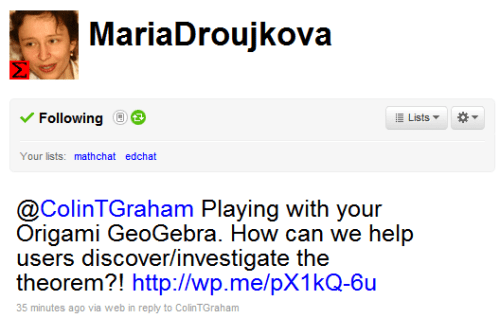
Addendum: A Tweet from @MariaDroujkova asking for how it could be usedAnything to oblige, Maria!  I added a screenshot which you could use in conjunction with the table above to check things out.  This is also available on the Mathematics Resources page on this site.  The sides of the square were set to 360 to allow for many different fractions to be investigated (elevenths may be a problem though!).  I expect I will expand the manipulative itself to encourage exploration sometime in the future… Anyway, enjoy!

OK: Here is the dynamic worksheet if you want to try it out online!
(added 6th September 2010)


Technorati Tags: ,,,,,,,,,,

Who did you help today?

This is just a short post.  I want to dedicate it to the memory of Rob Henry who passed on 4th September 2003.  The Gas House Gang (GHG) will always remain in my top three Barbershop Harmony quartets, no matter who wins the title of champion in the future… But, I ask myself “Who did you help today?” every day, without fail.  Any day where I feel I did not help someone with something, however insignificant it may seem, is a day I feel I have wasted.  Life is precious.  I have decided to make “Who did you help today?” a motto, to help me honour Rob, and also to remember that any day you lose without helping someone is a day that is lost forever.

Now, all I have to do is choose a video or song from the GHG site… Tell you what, you choose!

Live forever, Rob!

Aside

I have to say that a number of people, myself included, have been blithely stating that Twitter could be used in class for data-collection, surveys, etc. without actually having fully thought through some of the non-technological challenges that might be involved.  I thought it would be an interesting idea to test it out with a mini-survey of my own, but to include some ‘pitfalls’ or potential barriers to conducting a valid data-collection.  This was definitely my statistician’s geekiness coming to the fore here, I think!

So, in the best traditions of ‘scientific’ data-collection, I started off with some imposed constraints, which could then be varied at a later date if desired, and some hypotheses based on my predictions about the outcomes.  The main idea behind the experiment was to create a kind of mini-manual about what to expect when conducting this kind of activity in future.

Constraints

  1. The experiment would run for 24 hours.
  2. I would only use the #mathgeek hashtag and rely on my followers to retweet.
  3. The instructional tweet would be 140 characters long, requiring editing for retweets.
  4. If anyone asked me questions directly about the task, I would respond according to the initial instructions only.
  5. Other questions would be answered without ‘giving too much away.’
  6. If needed I will provide up to 2 additional prompts by sending the original message again.

Hypotheses

  1. Elementary/primary school followers, and non-maths teachers, will probably tweet integers.
  2. Followers who tweet integers will probably tweet 7, especially North Americans.
    [Based on other trials such as “Is ‘17’ the most random number?”]
  3. No-one will tweet 1 or 10. [Based on intuition.]
  4. Secondary or higher level maths teachers will probably make some reference to ‘jargon’ and/or tweet irrational numbers.
    [Because they are more likely to be ‘geeky’!]
  5. Followers who tweet irrational numbers will probably chose φ,π or e, or some kind of surd – probably √2 or √5.  It would be interesting, but probably unlikely, to see: ζ(3) [Apéry’s constant], ρ [plastic number, sometimes called the silver number], δS [the silver ratio] , δ and α [the first and second Feigenbaum constants].
  6. The instructional tweet will be edited at the end rather than the beginning – i.e. the instructions will be ‘lost’.
  7. Not everyone will retweet my original tweet as is (possible with Twitter.com, but not where ‘editable’ tweets are available).
  8. Not everyone will retweet my original tweet or an amendment of it.
  9. Some people will tweet more than once, since no limit was imposed on how many numbers could be tweeted.
  10. There will be some extraneous ‘noise’ generated by those participating in the experiment.
  11. An Übergeek will probably say that it is numerals rather than numbers which are being tweeted (but only if they are into Number Theory!).

Set-up and preparations

Firstly, I set up an archive on http://twapperkeeper.com/index.php, and also subscribed to #mathgeek using Google Reader (using the Twitter search http://search.twitter.com/search.atom?q=%23mathgeek as an RSS Feed).  I also considered using What the hashtag ?! as an additional backup, since experience with #mathchat moderation suggested that Twitter is not always 100% reliable at keeping all of the tweets!

Then, I sent a test tweet consisting only of the hashtag #mathgeek, to check that the setup worked, and to provide a point of reference for when the experiment was going to begin.

The 140-character tweet I sent out to kick things off was:

Tweet sent out to start #mathgeek

Tweet sent out to start #mathgeek

Analysis of Results

The contents of the TwapperKeeper archive of #mathgeek contain duplicated tweets, for some reason, so it required editing before analysis.  The end date in the search had to be extended beyond the 24-hour period, otherwise some tweets sent during the allotted time were missed.  You can carry out your own analysis of the results if you like, by clicking on the link and downloading!

Some special symbols can get distorted by the archiving process, for example:
Ï€ appears instead of π (1-byte versus 2-byte character representations), so it’s best to check with the original when editing any archives for analysis.  Tweets have a unique ID number, so duplicates can be identified easily.  The edited version of the archive is available as a public Google document. One response was sent to me as a Direct Message and not as a Tweet to #mathgeek, but I decided to be kind and include it!

So, after editing and the inclusion of the DM, which was “2 #mathgeek”:

Total responses: 125

Noise/unrelated: 15

Questions/Answers: 9

Retweets: 32

Accepted responses: 68

Discounted: 1 because: (a) it just said “Avogadro”, and (b) Avogadro’s constant, being 6.02214179(30)×1023, is outside the limits asked for.

Numbers tweeted (frequency):

Integersimage

1  (3)

2  (4)

3  (2)

4  (6)

5  (4)

6  (7)

7  (11)

8  (5)

9  (1)

10 (0)

Decimals

3.14157 (1)

3.14159 (1) – could be approximation to π?

3.14159… (1) – suggesting non-recurrence, could be π?

7.705519 (1)

8.3  (1)

9.8  (1)

Irrationals

√g (1)

e (5)

phi = [1; 1 1 1 1 …] = {1+sqrt(5)}/2  = 1.61803399… includes “golden ratio” (4)

pi/π (5)

eπ (1)

³√112 (1)

sqrt{42}  (1)

3/e (1)

Test of hypotheses

I do not feel that any statistical significance can be attached to these findings, but if you want to apply tests, be my guest!

  1. Still to be analysed but appears to be the case!
  2. True, since 7 was the most frequent response amongst the integers – North American-ness to be determined!
  3. False – 3 respondents tweeted 1
  4. True, first mention of integers came from a secondary maths teacher @TeaKayB, and first irrational number from someone whose job was to promote mathematics in universities @peterrowlett.  Subsequent tweets with irrational numbers seemed to come from people within Peter’s network on Twitter.
  5. True φ,π or e, or some kind of surd were tweeted, with e and π being slightly ahead of φ, and also included a single eπ.
  6. False, the “Are you a #mathgeek?” was removed from the original when RTed.
  7. True, at least 3 different versions of the instructions were available by the end of the experiment.
  8. True, 68 responses versus 32 retweets.  This may be because @peterrowlett removed the request to RT in his adaptation of the instructions.
  9. True, but only one person did this.
  10. True, 15 responses were not directly related to the experiment itself, although some comments were generated by it, including the first two!
  11. Undetermined, since there were no Übergeeks!

Observations

As a data-collection activity, I feel this was reasonably successful.  For future experiments to be successful using Twitter, I think:

  • a more specialized hashtag would be better.
  • instructions should be in a tweet about 120-characters long to reduce chances of re-editing.
  • a longer time period could/should be applied with RTing at timed intervals to allow for global participation.
  • anyone who ‘hijacks’ the instructions should be contacted and asked to RT original as far as possible.
  • Google Reader did not retrieve all of the Tweets sent during the experiment, so it is best to have two or three archives available for analysis.
  • graphs and data charts provided by archive software will also contain extraneous ‘noise’, if people ask questions or discuss the activity using the hashtag.
  • any archive will probably need to be edited before analysis.

So, over to you now… let me know if you want me to take part in your data-collection activity!

Torture numbers, and they’ll confess to anything! [Gregg Easterbrook]

Aside

In this case, I am not going to talk about real numbers which cannot be represented by an integer fraction or a recurring decimal.  Instead I want to talk about normalized percentages.  “What makes these irrational?”, I hear you say.  Their application to examinations and assessments is what.  During the past week or so, two sets of examination results have been released in the UK – the A-level (two or three of which are usually required for entrance to university) and the GCSE (usually seen as a ‘basic’ qualification in a subject if grade C or above is obtained).  These results largely affect England, but many schools in Northern Ireland and Wales, and a few in Scotland, also take them.  For my non-UK readers, the four countries making up the UK each have their own education systems – you can find an overview in the #mathchat Wiki!

The A*

The big change for students completing A-levels this year was the introduction of the A* – an attempt to increase the value of the ‘gold standard’, as I see it.  At the time of its introduction, there were some who saw it as being pandering to the elite, however.  The history behind the A-level and GCSE is well summarized in an article from Politics.co.uk.  Incidentally, I find this is a good site for information/news related to politics in the UK, since it’s articles are written to provide useful references as well as breaking news, and tend to be more balanced in their points of view.

To get an A*, you must meet the following two requirements:

  • 80% UMS overall (the current requirements for an A),
  • 90% UMS overall in the A2 units.

UMS is the uniform mark scheme/scale (uh-oh, here be dragons!).  You don’t get an A* for 90% overall. Only the A2 units (i.e. the units normally taken in Year 13, the final year) count towards the award of an A*. Even if you get 100% in your AS units, 89% in your A2 ones isn’t enough for an A*. Similarly, you don’t need to get an A at AS to get an A* at A2 if you get 90% in the A2 units, and assuming your A2 marks are high enough to pull your AS marks to an A grade overall.  Unless of course you are taking Maths, Further Maths, Further Maths (Additional), Statistics, and Use of Maths AS. No AS will have the A* grade available.  Although some of the individual units in the Edexcel A-levels have been modified; see here [The Student Room, an excellent online student resource in the UK] .  You can get some idea of the complexity of what is involved by looking at the course structure for Mathematics, for example.

Ho hum….

The A* itself is being awarded to help universities (and others) distinguish better between candidates who had three As.  Some universities, for example  Cambridge, announced what their standard offers were going to be: in some cases for most subject entries, in other cases only for specific degree subjects.  Most of the subject entries, at a quick glance, seem to require mathematics, and some universities specify that the A* has to be in A-level Mathematics (naturally enough if you have a reputation for science education such as Imperial College).  Imperial College, however, has also stated that it will be introducing a university-wide entrance exam for all applying to study there from 2010, because “We can’t rely on A-levels any more.” [Sir Richard Sykes, Rector of Imperial College quoted in The Sunday Times].

“We are going to have entrance exams that will test ability. We are looking for students who really will benefit from an [Imperial College] education. The examination will look for IQ, intelligence, creativity and innovation and will not be too dependent on rote learning.” [Sir Richard Sykes, ibid]

As far as the A* itself is concerned, there is a big “but”.  The grade is only being awarded to people sitting their final A2 exams from September 2009 onwards (the grade first being available in the summer 2010 certification just past). This means that people who took their AS-levels in summer 2009 or before will not be able to get A*s.   Except, of course, that if one of your A-level modules was Use of Maths, which is an AS and not eligible… dum-di-dum.

I hope you’re keeping up, you’ll be tested later!

I have one word which I feel would address most, if not all, of these issues: portfolios.

GCSEs and the bell-curve

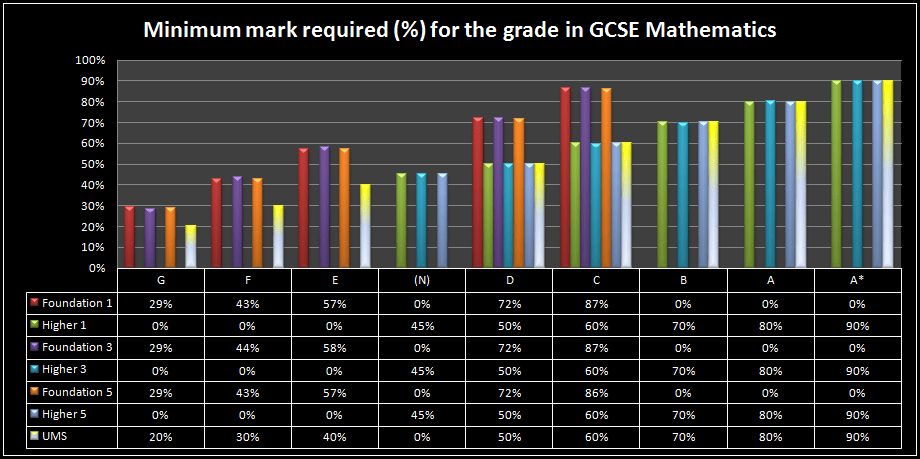
First of all, it would be unfair to proceed without providing a link to the official summaries about the GCSE (sanitized for you protection, of course).  There is, of course, a UMS for GSCEs as well.  This is the UMS for GCSEs from AQA, which is the largest of England’s three examination boards.  OK, first question: in a 30-page book explaining uniform marking (AQA‘s), would you be a little concerned if 19 of those pages were tables of boundaries for various different grades and subjects?  As a statistician concerned with validity of data collection and comparison, no.  As a teacher, particularly of Mathematics!, yes.  Second question, do these tables as they are give a clear picture of where the grade boundaries lie?  Maybe not… let’s try a chart using Table 6 from Appendix A of AQA’s leaflet which shows GCSE Modular Mathematics (Specification B) (4307) two-tier without coursework.  You can make your own chart if you want something else!

Minimum mark required to get a particular grade in GCSE mathematics.

Basically, grade C is considered as a pass.  This is a two-tier GCSE and a pass level is available in both tiers.  In this case there is no coursework element.  Coursework is usually marked by teachers in the school using a preset scheme and then verified by external examiners. The N grade is only given in the higher tier to those who fail to achieve the minimum required for a grade D.  No account has been made here of the weight carried by each of the three modules and their contribution to the UMS score.

A couple of things stand out to me now, with the visual presentation of the data:

  1. The UMS is clearly aligned to the marks in the higher tier modules, where all grades except for D are considered as a pass.
  2. Lower tier students (oops, I mean foundation…) are expected to work proportionately harder to achieve the higher grades than those doing the higher tier.

In respect of 1, this is hardly surprising since the idea behind the grades and uniform marking schemes seems to be that a particular chunk of marks of a standard size represents an increase in grade or level.  The word grade, after all, derives from the Latin gradus meaning a step or degree.  We don’t build staircases with uneven step heights, unless it’s absolutely unavoidable, so we don’t create grading systems with uneven steps either, do we?

In respect of 2, the bar heights for a grade C in the Foundation tier lie between those for A and A* in the Higher Tier, similarly grade D bars in the Foundation tier are slightly above those for a grade B in the Higher.  Now this seems inherently unfair, to me: to be asking lower-ability students to work harder than their higher-ability counterparts, who should be capable of working at higher levels and, perhaps, are not being sufficiently challenged.  The following chart shows the contribution of the modules by weight to the grades for both the higher and foundation tiers, which shows the disparity more clearly, I feel:

image

I suspect this disparity comes from ‘normalizing’ the Foundation level grades by using bell curves.  I could go into more detail, but Professor Miller does a good job of explaining this concept for one of her biology courses, so I am not going to reinvent the wheel.  The student grades are then probably normalized each year to make sure the appropriate number of students achieve passes at that grade, so making it more difficult to make comparisons from year to year… or am I pushing the boundaries beyond belief here?

Now, if I am trying to decide whether or not that person in front of me, with a grade C in Mathematics, is someone I think will be able to work for me or progress to the next stage of their education, I have a problem.  I don’t know whether or not they don’t know 40% of the curriculum or just over 30% of the curriculum. Or, did they do enough to get 60% of each question correct but not reach the final answer of any of the problems?  That’s a silly example, or is it?

The point is, a grade may tell me something about a student’s knowledge of a subject, but it doesn’t tell me what they can or, more importantly, cannot do!

I have one word which I feel would address most, if not all, of these issues: portfolios.

Anyone spotted a theme here… 😉

Aside

As readers of my blog, or people who know me, already know, I have been out of the UK for over a decade.  Still in one of my reflective moods, I have been talking to various people about the changing rôles of senior management in schools, the impact of the new coalition government and their slashing of funds for education, the disappearance or removal of various QUANGOs and ‘institutions’, and the new academies and ‘free schools’ [yes, I read the Guardian a lot, but it’s not my only source!].  These are, to say the least, uncertain times… I’m not sure yet if they are interesting though!

Having never had to run a department, let alone a school, I wonder how apprehensive the management teams are about all these sudden changes.  I also wonder how those of us who are not in management positions can best support our colleagues.  For some reason, I was reminded of the talk Barry Schwartz made to TED back in February 2009 Barry Schwartz: The real crisis? We stopped being wise.  I dug out the notes I made at the time I watched it last year and a number of bells began to ring!

Here are my notes from the video, together with my current reflections on them as a non-management teacher:

A wise person:

  • knows when and how to make the exception to every rule
  • knows when and how to improvise
  • is like a jazz musician – using the notes on the page but dancing around them
  • uses moral skills in pursuit of the right aims – serving not manipulating people
  • is made, not born

What happens when rules you have been following for some time are suddenly removed by the government?  What happens if you have the responsibility of making your own rules for running a school?  If wise people are made rather than born, how does that work and when does it have to start?  How far can you improvise before you lose the plot?

You need the time to get to know the people that you’re serving.  You need permission to be allowed to improvise, try new things, occasionally to fail and to learn from your failures.  You need to be mentored by wise teachers.

How well do you really know the people you are working with, let alone the people you are serving?  Who are the people you are serving: parents, governors, local authorities, students…? How do we handle failures within the system?  Where do the wise teachers come from if a situation is completely new?

You don’t need to be brilliant to be wise, but without wisdom, brilliance isn’t enough.

The main thrust of what Barry Schwartz was saying about wisdom also seemed to be tied in to experience and length of time spent working with the wise teachers and mentors.  Whilst many situations may be new to the management of schools, people have been managing businesses for years: running meetings, controlling budgets, hiring and firing people, etc.  Perhaps the time is ripe for schools to get some wisdom from local businesses, since some of their students may be future employees or business owners.  The way things appear to be headed in the UK, to me as a recent returnee, seems to be that school = small business!

“We hate to do it, but we have to follow procedure.”

This came from the lemonade story.  Watch the video!  Is this just an excuse? Or maybe it’s ‘passing the buck’ because:

Rules and procedures may be dumb, but they spare you from thinking.

Do we do enough critical thinking about the rules and procedures we follow or do we accept them as they are because they are mandated and if we don’t have to question them it gives us more time to…?

Tools: Rules and Incentives – better ones, more of them.

My first, knee-jerk reaction to this is unions and government.  Unions are great for collective bargaining and imparting a voice to those who would otherwise be disenfranchised.  I think teachers do need to be properly valued within society, but I wonder how many teachers are more interested in what funding is available for them to give up their ‘precious time’, rather than finding time to add value to what they are already doing by self-improvement.  Governments tend to introduce ‘outrageous’ rules, some of the Health and Safety legislation in the UK springs to mind, because a small minority always manages to find a way around the existing rules to do what they want and to spoil things for everyone else.  These people will always find a way, because they are selfish and new rules are not going to change that.

Moral skill is chipped away by an over-reliance on rules that deprive us of a chance to improvise.

Rules and the War on Moral Skill:

  • the lemonade story
  • scripted, lock-step curricula (don’t trust teacher judgement)

How far have you actually tested the rules and procedures in your school?  OK, maybe I’m being subversive here, but I’m sure some of you who are reading this have ‘bent’ a rule or ignored a procedure because of the relationship you have with your management/parent/student.  Do we highlight or discuss these situations to try to bring about a change, or do we keep quiet because we don’t want to be disciplined for ‘breaking the rules’?

Moral will is undermined by an incessant appeal to incentives that destroy our desire to do the right thing.

Incentives and the War on Moral Will:

  • motivational competition (two reasons are better than one?) “What is my responsibility?” versus “What serves my interests?”

I will categorically state that if I got paid a bonus for writing a blog, I would probably start treating it as piece-work and demanding payment by the word.  I know that the quality of what I am writing would suffer.  If I knew that I could get extra credits for attending online conferences and moderating twitter discussions, I’d be all over it… Actually, no I wouldn’t.  I would stop it altogether because it would no longer have any meaning for me.  I might go through the motions if it was mandated, but…

Remoralizing work:

  • celebrate moral exemplars
  • Aaron Feuerstein and Malden Mills

This speaks for itself, both in terms of increasing morale and introducing a moral dimension to the workplace.  For UK readers, or others, who are unfamiliar with the Aaron Feuerstein story, here is a link to start with.

Unless the people you are working with are behind you, it will fail. Different people in different communities organize their lives in different ways.

Is the staff, are the parents, are the students behind the ‘vision’?  What works in London is not necessarily going to apply in Halkyn, and vice versa.  As one of the sources of education for the community, schools are probably well placed to decide what really works for everyone.  However, schools are not the only source of education in the community.  We would do well to remember this!

Paying attention to what we do, to how we do it, to structure of the organizations in which we work, so as to make sure that it enables us and other people to develop wisdom.

Well, this brings me back to the words I chose for the title.  In times of uncertainty and change, it is especially important to be kind to one another.  Tell someone if you think they have been unkind.  I did this today, and it turned out that it was something I had misunderstood because of missing context.  I could have got really worked up about it and ignored the comment and the person, but I challenged what had been said.  Thankfully, everything was worked out with no blood lost!  People are not psychic – they cannot guess how you feel, especially if they don’t know you!  Take more care with what you do, think about things carefully and critically before taking action.  And, at least, try to empathize with the people around you, whatever their position or status, if you can start to see the world through their eyes, then times will certainly become more interesting and less worrying.

Aristotle summed it up in one word: φρόνησις

Aside

Anyone who’s moved house once or twice will know that you go through a stage of unpacking the important boxes, and leaving a few boxes lying around until you get the rooms sorted out the way you want!  My blog has been in a similar state of transformation.  I have been working on finding a layout and theme that I like for it and think this is probably going to be it!  My home page is now a static page, rather than a ‘sticky post’ and I have been exploring a few of the other features of widgets in WordPress.com as well.  I have got into the habit of writing my blog posts using Windows Live Writer, and Mike McSharry also has a very helpful manual to help get started!  It is also very worthwhile considering using Live Writer as a front-end for publishing school blogs, since it avoids the rather unpredictable advertising you might get by logging in directly to WordPress.com directly.

The availability of the Tweet button for posts in WordPress.com is also very welcome.  In case you haven’t found it yet, look under Appearance>Extras and select the ‘Show a Twitter “Tweet Button” on my posts’ check-box.  Social media appear to be becoming more and more important, so I have put my three main buttons at the top of the page, where they are easier to find.

Other little tweaks included getting my logo on as an icon, rather than the default W, setting up some file-sharing facilities and tidying up one or two tags and categories.  I also decided a clickable menu at the top of the page would be a good idea.  Oh, and don’t forget the new title!

I’ve decided to consolidate my links into pages, together with other resources, and this is still on-going… so be patient!

Any comments on the new layout are welcome, will be read, but not necessarily acted on… 😉

Aside

It seems a natural thing for educators who are like me to spend time reflecting on themselves and their work, and then for them to take action on their reflections.  In my own case, the reflective process is also combined with a lot of reminiscence and re-evaluation of where I am and where I want to go as a result of my return to the UK after 11 years in Japan.  On top of that is returning to the small village in Cheshire where I lived whilst going to school.  I mentioned, in a previous post, how I grasped mathematical concepts at an early age, and I was also moved ahead one year when at primary school because of my ability.  I am not certain this was a good thing for me socially or emotionally.  Because I was already one of the youngest in my own year-group, it created a two-year gap between me and most of my classmates.  I also hated the particular teacher that was foisted on me for two years, too. It did provide me with a mental challenge, though.  My mental abilities allowed me to attend a top-end school where I was one amongst many: good at some things, average at others.  I took an IQ test and spent a year or so as a member of MENSA, shortly after leaving university.  So it’s fair to say I have a strong belief in my mental ability, if nothing else!

A week ago, I took part in a #gtchat on Twitter, for parents and teachers of gifted children, discussed the nature of assessment and grading with many people around the world, watched Sir Ken Robinson’s (by now) well-known talk about creativity again and attended Angela Maier’s session at the global e-conference “Reform Symposium 2010“.  All of which has been floating around in my head recently, together with questions about achievement, success, creativity and the nature of genius.

I ‘buy in’ to Howard Gardner’s theory of Multiple Intelligences, whether or not intelligence is the correct word to use or not.  I used the seven initially identified in my teaching, whenever it was feasible to do so, and later added both the naturalist and existential intelligences, despite Gardner’s reservations about the latter.  I had also recently read a paper (Leadership out of the box) which referred to a possible correlation between an enneagram test and Myers-Brigss personality types. So I put together nine people, or partnerships of people, who represent to me the types of intelligence I would like to emulate or develop for myself.

Angela Maier’s session provided a focus for my random thoughts.  She concentrated on her concept of ‘habitudes‘ (which I have to say sounds very Californian to me!), as well as the value and importance of asking the right sort of questions.  When she introduced her vision wall, I was reminded of my own collection of nine MI people or partnerships – which I refer to as my enneasophist (ἐννέα nine σοφος skilled) wheel.  I will write a separate post about how I developed this and made my choices, otherwise this post would be way too long!

An enneagram of multiple=

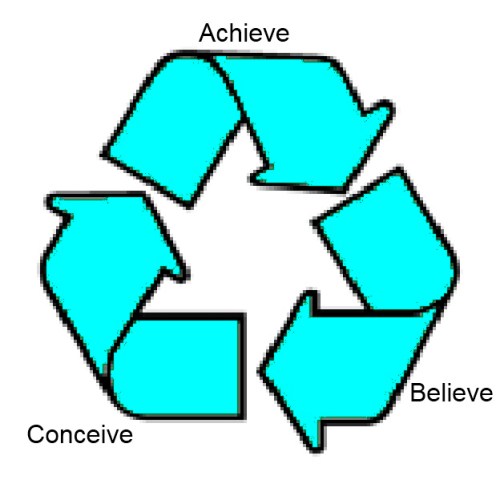
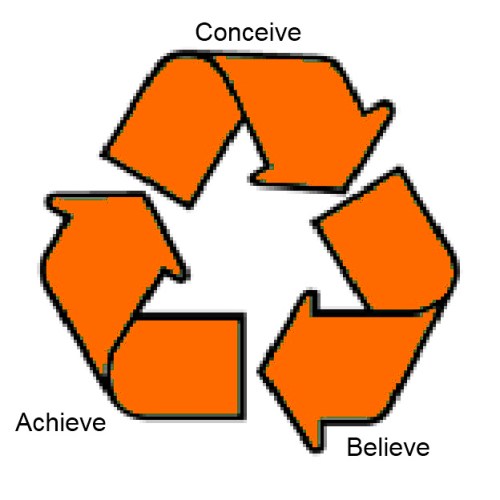
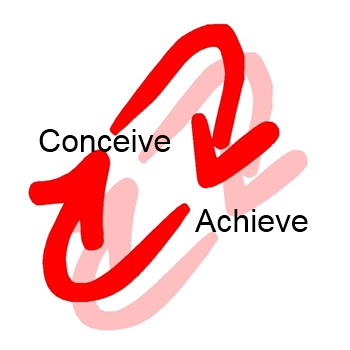
During her session, Angela was talking about ABC posters related to habitudes in her classroom, and I commented that “I like to think of a reverse ABC: Conceive, Believe, Achieve”.  It seemed to fall on ‘deaf ears’ (or maybe I should say blind eyes) in the session itself, but I was not following the Twitter backchannel on #rscon10.  My comment had been tweeted out, and retweeted 12 times within an hour – a new experience for me – and made me decide to expand on the meaning of this and how I relate it to my ideas about achievement and the nature of genius.

I think of two basic cycles or loops in relation to the ABC: achievement leading to belief leading to conception leading back to achievement, and conception leading to belief leading to achievement leading back to conception.  The first I describe as the Esteem Loop, the second as the Imagination Loop.

The Esteem Loop

The Imagination Loop

Obviously, any of the three words could appear at the top of these loops, giving six possible configurations, but I have chosen and named these deliberately.  It seems to me that most young children have an idea, they have no doubt it can be done, and they do it.  This is the imagination loop, with the conception of the idea as the focus, initiator and generator of the cycle.  Over time, I think this productive loop is transformed, by the pressure of assessment, grading and the ‘need to achieve’, into the esteem loop.  The focus here is on achieving something, the achievement is used to build belief in ability and, if we are lucky, the student will conceive some way to improve their achievement or have an idea about something else they might be able to do.

If a system is built on exploring ideas based on beliefs about how achievable the ideas are, or whether you have the skills to carry them out, what happens if there is a failure to achieve?  What happens is that you need to spend time trying to convince learners that they have achieved something, even though they are likely to feel they have not.  I am sure we have all seen the natural curiosity and creativity of four-year-olds almost totally eradicated and systematized into some kind of assessable or measurable ‘achievement’.  In doing so, however, I feel we are ‘breaking’ what I see as a creative/productive cycle, where belief in an idea leads to an achievement which generates further ideas.  For me, belief in ideas and a willingness to explore their possibilities is more likely to produce and maintain an active, learning mind, as well as leading to a greater sense of achievement or satisfaction.  This is where I see Angela’s habitudes fitting into education.  This is also more likely to lead towards what I call the Genius Loop, where conception and achievement feed directly into each other.

The Genius Loop

I have to say that I don’t agree with Angela’s statement “you are genius” as directed to every child.  Although I do understand and sympathize with the sentiment, for me it sets up two conflicts: it devalues ‘true’ genius in whatever field (and whatever genius is); and it may create unrealistic expectations for the person it is said to or about.  For me, a genius skips over the ‘belief’ part of the cycle.  For a genius, there is usually no need to believe in your ideas or creation, you just know instinctively that it is right or it will work.  True geniuses, for me, are absolutely consistent in this feedback loop and rarely doubt themselves or fail to believe in their work: when they do, it can lead to breakdowns or personal crises (Sergei Rachmaninov springs to mind).  I do think we all have moments of genius, though.  Perhaps this is the moment described by Csíkszentmihályi as flow.  So, I would like to tweak Angela’s statement to “this is genius” because I think this will help reinforce belief in the idea or the model of what is expected, and not belief in the achievement.  I do, though, believe that Angela’s approach will increase the number of moments of genius that her students will experience in her class and in the future.

As a parting thought, when was the last time you felt a sense of achievement over something?  Was it an idea you had and put into action, or was it when someone told you that you had done a good job?

Aside

I am going to start with a question,  what is this?

2 x 3 = 6

We’ll come back to that later… The first part of this post is going to be devoted to a bit of background about my journey in mathematics and where the title came from.  No, you didn’t mis-read, I do think that mathematics is a language, with its own culture and literature, but seemingly inaccessible to the non-speakers.  One of my earliest memories of mathematics comes from being taken aside by my class teacher and asked to explain Napier’s Bones to the Headmaster.  I was around 8 or 9.  I thought this was a bit strange, because the mechanical application is quite straightforward and most of the rest of the class was able to use them to multiply, and fewer of them could also divide.  I didn’t know why I had been chosen to ‘explain’ to the Headmaster.  So, I demonstrated.  He asked me some questions, gave me a few ‘sums’ to do, and then said “Do you know why this works?”  I said I did and went on to explain about the placeholder system.  Now I look back, I can see why I was probably singled-out: I had grasped the concept behind the tool.  It still seems perfectly natural to me, and I really don’t know what it’s like not to get the concept – wherein lies the problem or challenge!

Those of you, like me, who ‘get it’ and, more to the point, understand and enjoy teaching mathematics probably feel the same frustration as a tourist in the Brazilian rainforest trying to describe a 4G phone to an Amazonian who knows what telephones are, but doesn’t really see how they can be useful in hunting tapir… At least, if you’re anything like me you will!

Another ‘oddity’ about maths teachers is that they tend to congregate.  At virtually every event I’ve been to – plays, concerts, operas, races, conferences – when I’ve got into a long conversation with someone, rather than just the social niceties and small talk, it has also turned out to be another maths teacher.  Teachers do tend to gravitate towards other teachers, but it always seems that maths teachers form their own little subset.  Is it because we listened to Mozart in the womb, or is it because nobody else really understands the language of maths teachers…?

There is or seems to be a thrust towards (re-)introducing problem-solving in early years rather than the so-called “drill-and-kill” methods.  This may be a good thing, especially if young children are encouraged to use their creativity,  imagination and natural curiosity to explore applications of number.  Yes, application of number rather than mathematics, because if you believe Piaget’s developmental stage theory the ability to grasp the abstract concepts behind mathematics is probably not going to happen until the formal operational stage.  Personally, I am with Vygotsky in thinking that language plays a greater rôle than Piaget assigned it in cognitive development, and my long-term research interest is in the impact  the language used in teaching has on the learning of the subject.

So, back to the opening question, what is this?

2 x 3 = 6

Student response: “What? That’s a stupid question! Why are you asking this?”

Parent response: “It’s sums, isn’t it?” or “Hmm, maybe a formula or an equation, not sure…”

Maths teacher response: “Well, it depends.  It is, of course, a symbolic representation and although primarily a basic arithmetic fact, you know that arithmetic is what most people mistakenly call mathematics, it has been taken out of its context and….blah, blah, blah”

I exaggerate, I hope!  But if you are really honest, isn’t it a symbolic representation of:

two times three equals six,
two threes are six,
dos por tres es igual a seis,
zwei mal drei gleich sechs
deux fois trois font six
два раза три равна шесть….

I think you get the point.  Maybe if we have a mindshift, as maths teachers, towards thinking of our subject as a language, the language of abstraction (perhaps the most difficult language of all to learn), with its own culture and literature, and give our students the opportunity to see where and how number is used and is useful, there will be less “phobia” and more “philia” of something we already love, know and enjoy!

Aside

This was the guest post I was asked to contribute following #edchat on 13th July 2010 (17:00 – 18:00 my time!). It will be interesting to see what kind of response, if any, it provokes. I must admit it is quite an interesting experience to have to go back and look at what was said from a critical or dispassionate point of view. I have occasionally revisited archived chats to remind myself of links, or gone back to try and trace through what a particular sub-stream was discussing, while I was engaged in responding to others, but I still find it staggering that people retweet things within 10 or 20 seconds of their first appearance, without comment, or that they don’t go back and revisit earlier points that have been allowed to die off or get completely ignored. I’m sure it’s not just me that feels this, but at least the archive is there for people to come back to you after the event, and explore opportunities that they may have missed or failed to pick up on at the time. In some ways, too, it has made me try to reflect a little more on what the best way to participate in this kind of discussion – particularly from the perspective as one of the moderators of #mathchat… Feel free to comment here or on the main post!

What should be the first two problems addressed in order to begin educational reform? #Edchat 7-13-2010 – 18:00 CET 12 PM EST   Our thanks go to Colin Graham (@ColinTGraham) for this week’s #edchat summary. It is a very frank and honest resume of his thoughts on both the topic and the progress of the discussion. He invites comment and it will be interesting to see how other edchat participants react to his point of view. Colin is a regular and enthusiastic edchatter and his committment to education is very clear (see his bio at th … Read More

via Rliberni’s Blog – Radical language